


Coventry City – CBS Arena
- Jimmy Muir

- Feb 11
- 9 min read
Coventry City Football Club has one of the most intriguing histories in English football, both in terms of its development as a club and the challenges surrounding its home stadiums. Formed originally as Singers FC in 1883, named after the cycle company that many of the founding players worked for, the club’s early years were defined by its working-class roots and connection to the industrial heritage of Coventry. The city itself was a powerhouse of British manufacturing in the late nineteenth century, and the club grew steadily out of that environment. By 1898, Singers FC adopted the name Coventry City, cementing its identity not just as a works team but as the representative footballing force of the city.
The club spent its early years in various local leagues before entering the Football League in 1919, following the First World War, when the Second Division was expanded. That milestone was a significant one for a club that had always harboured ambitions to join the national competitions, and it established Coventry City as part of the wider professional game. For the next century, the club would endure highs and lows that mirrored not only the fortunes of Coventry as a city but also the difficulties of surviving in English football’s shifting landscape.
Before reaching the present day and the CBS Arena, Coventry’s history was dominated by Highfield Road, their long-term home. Prior to settling there, the club had used several smaller grounds. In its very early years, the team played at Dowells Field and then Stoke Road, where the growing crowds soon made it necessary to seek a more substantial home. In 1899, Coventry City moved to Highfield Road, which would serve as their home for more than a century. That ground became synonymous with the identity of the Sky Blues, a place where generations of supporters lived through the club’s triumphs and tribulations.
Highfield Road itself was a ground of much character and underwent significant development over time. It became the first all-seater stadium in England in 1981, when then-chairman Jimmy Hill attempted to modernise the matchday experience. Although this move was seen as pioneering at the time, it ultimately proved premature, as seating everywhere was not yet required by law and the reduced capacity made finances tighter. Coventry eventually returned terracing to the ground until the all-seater mandates following the Taylor Report after the Hillsborough disaster. The stadium witnessed many memorable matches, including top-flight games against England’s biggest clubs during Coventry’s long spell in the First Division, as well as European fixtures when the Sky Blues qualified for continental competition.
The most famous day in Coventry City’s history came away from home, however, at Wembley Stadium in May 1987. Managed by John Sillett and George Curtis, the club defeated Tottenham Hotspur 3–2 in an FA Cup Final that is still widely considered one of the greatest in the competition’s history. Keith Houchen’s diving header became an iconic image, and the victory delivered Coventry their first and only major trophy. For a club often considered outsiders in English football, this triumph was symbolic of the spirit and determination that had characterised their story. The celebrations at Highfield Road when the cup was paraded before supporters remain etched into the memory of the city.
By the 1990s, however, Highfield Road was showing its age. The demands of modern football, the need for revenue streams beyond the matchday gate, and the changing expectations of supporters meant that Coventry began to explore the idea of relocating. Plans were drawn up for a new stadium in the early part of the decade, initially tied to England’s bid to host the 2006 World Cup. The ambition was for a state-of-the-art arena that could not only serve as Coventry City’s home but also attract international fixtures, concerts, and major events.
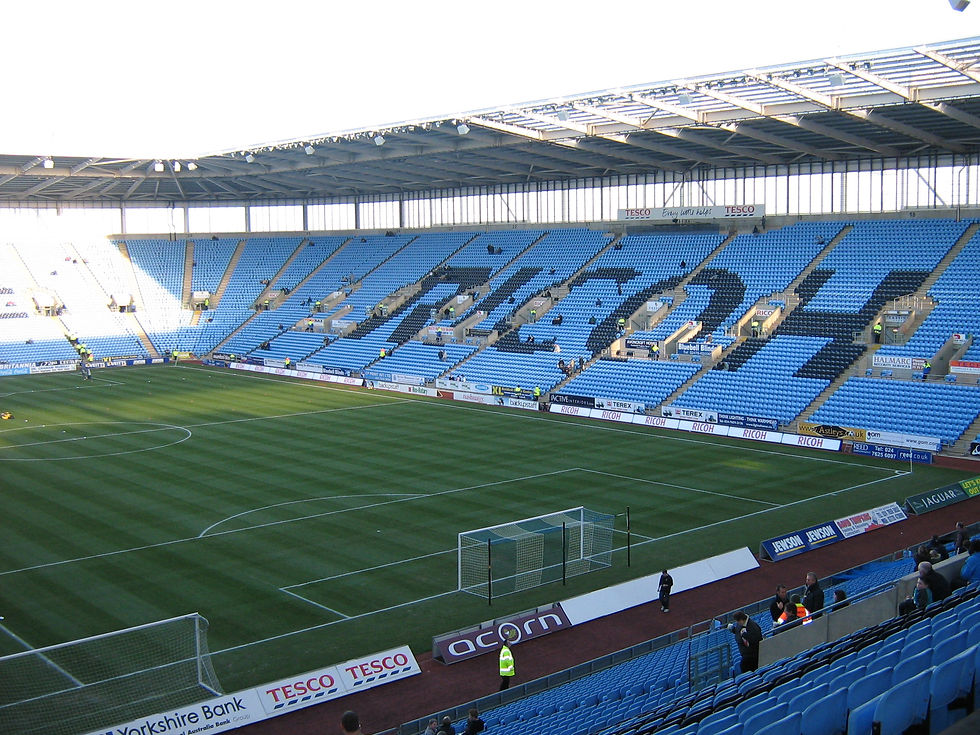
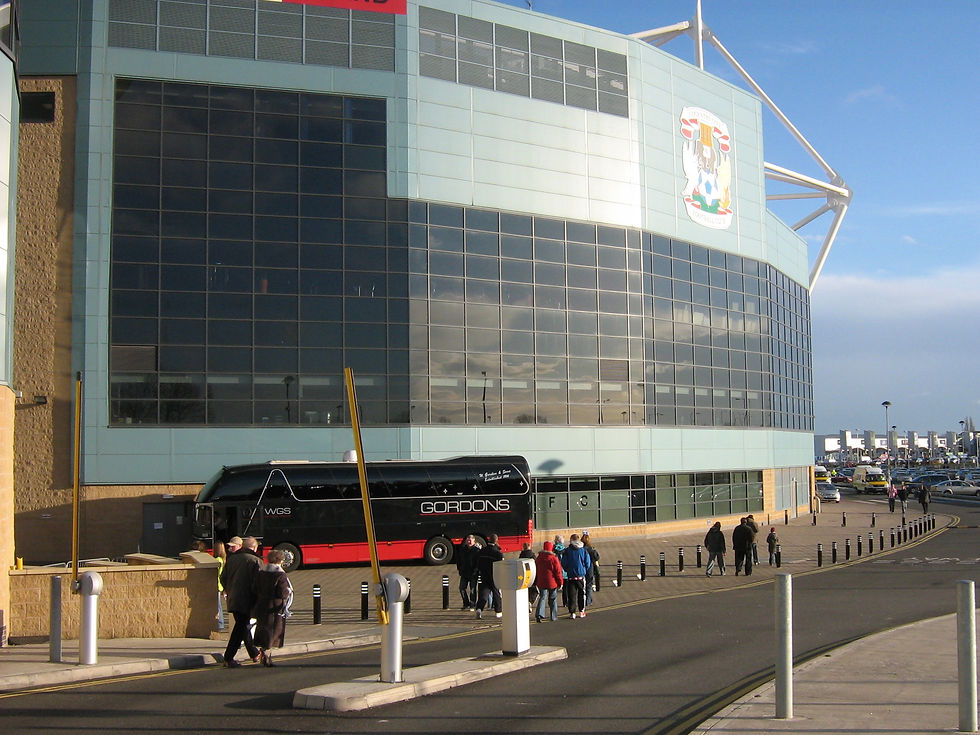
After years of financial challenges, delays, and planning disputes, the project finally came to fruition in 2005 when the Ricoh Arena opened its doors. Located in the Foleshill area of Coventry on the site of the old Foleshill Gasworks, the stadium was a dramatic departure from the old Highfield Road. Its opening marked a new era, providing a modern facility with around 32,000 seats, conference and exhibition spaces, and connections to wider commercial development, including a hotel and casino. It was intended to provide Coventry City with the financial stability to compete in the modern era.
The Ricoh Arena was first used by Coventry City in August 2005, with their opening match being against Queens Park Rangers in the Championship. The occasion was celebrated as a new dawn, with supporters filling the stands to glimpse their team in a modern arena. The move, however, was not without its difficulties. Financial complications dogged the club’s ownership and its relationship with the stadium’s operators, leading to disputes that would mar the otherwise positive aspects of playing in such a fine venue.
Despite these challenges, the stadium itself quickly established itself as one of the most impressive in the Midlands. Beyond Coventry City fixtures, it became a venue for major international events. In 2012, it played a significant role in the London Olympics, when football matches were staged across multiple British cities. For the duration of the Games, it was renamed the City of Coventry Stadium due to sponsorship regulations. The arena staged twelve matches in total across both men’s and women’s tournaments, beginning with the very first football fixture of the Olympics, which was also the first official event of London 2012. On 25 July 2012, Japan’s women defeated Canada 2–1 in front of a global audience, a match that symbolically opened the Games.
The Olympics brought world-class talent to Coventry. Brazil’s men’s team, including Neymar, Thiago Silva, and Oscar, played in the city, thrilling supporters with their flair and style. Mexico, who would eventually go on to win the gold medal, also featured at the stadium, giving the competition a competitive edge. The men’s quarter-final between Japan and Egypt was a highlight, drawing a passionate crowd and showing that Coventry could stage games of high drama and intensity.
The women’s tournament was equally memorable. Team GB played two matches at the ground, both of which attracted huge crowds and national attention. The defining moment came when Great Britain’s women beat Brazil 1–0 in front of over 28,000 spectators, a record at that time for a women’s football match in the United Kingdom. The sense of occasion, the patriotic fervour, and the quality of the match elevated the CBS Arena into the history books of women’s sport in Britain. It was a landmark in the development of women’s football, and the stadium was at the centre of it.
The Olympic experience left a legacy, proving that the CBS Arena could deliver international events of the highest standard. It has since hosted England under-21 fixtures and other youth internationals, giving Midland’s supporters the chance to watch the next generation of stars before they break into senior teams. In doing so, the ground has maintained its reputation as a venue fit for international football.
Attendances at the Ricoh, later CBS Arena, have varied depending on Coventry City’s fortunes on the pitch. The record attendance to date came in February 2018, when Coventry played Aston Villa in the FA Cup and over 32,000 spectators filled the ground. This atmosphere recalled the club’s great days of the past and showed the potential of the stadium to be a fortress when the club is successful. On the flip side, the ground has also seen sparse attendances during periods of turmoil, particularly when disputes forced Coventry City to groundshare away from their rightful home.
One of the darkest chapters in the club’s modern history came when ownership disputes meant Coventry were unable to play at their home ground. On multiple occasions, the club was forced into exile. Between 2013 and 2014, Coventry played their home matches at Northampton Town’s Sixfields Stadium, a deeply unpopular arrangement that alienated large parts of the fanbase and emphasised the fraught relationship between the club’s owners and the stadium operators. Later, between 2019 and 2021, Coventry again found themselves without the Ricoh, groundsharing with Birmingham City at St Andrew’s. These episodes caused considerable damage, not just financially but emotionally, to the connection between club, supporters, and stadium.
Eventually, however, Coventry returned home. In 2021, following new agreements, the club was able to re-establish itself at the stadium, by then renamed the Coventry Building Society Arena under a new sponsorship deal. The new name reflected both continuity and change: the ground remained the same physical location but was adapting to the commercial realities of modern football. The CBS Arena continues to be not only the home of Coventry City but also a multi-purpose venue hosting rugby union, concerts, and exhibitions. For a time, it was also the home of Wasps Rugby Club, further underlining its multi-use character.
On the pitch, Coventry City endured difficult years in the lower leagues, dropping as low as League Two by the late 2010s. However, under the management of Mark Robins, the club began a steady revival. They earned promotion from League Two in 2018, followed by a League One title in 2020. Their return to the Championship was marked by some fine football and growing crowds back at the CBS Arena, rekindling the bond between fans and their stadium. The near miss of promotion to the Premier League in 2023, when they lost in the play-off final at Wembley to Luton Town, was bittersweet but emphasised how far the club had come from its days of exile and uncertainty.
The CBS Arena itself has undergone transformations since opening. Various redevelopments have improved the hospitality facilities, with new lounges, expanded conferencing spaces, and better supporter amenities. The stadium has also modernised its pitch technology, improving drainage and undersoil heating to meet the demands of top-level football. Its use as a concert venue has brought stars such as The Rolling Stones, Coldplay, and Bruce Springsteen to Coventry, ensuring that the stadium remains a focal point for the city’s cultural life as well as its sporting one.
Future plans for the stadium remain an important topic for Coventry City and its supporters. There have been discussions in recent years about further upgrades to facilities, including improved transport links such as a dedicated railway station, which has already begun partial operation. The club’s ownership and relationship with the stadium are always subject to speculation, but there is a clear determination to secure a long-term home that avoids the mistakes of the past. While talk of building an entirely new stadium has occasionally surfaced, the CBS Arena remains the most realistic and logical base for the club in the foreseeable future, given its size, facilities, and connection to supporters.
Looking at the wider history of Coventry City alongside the stadium, the story is one of resilience. From its formation as a small factory team in the nineteenth century, the club grew to become an established member of the Football League. Its golden moment came in 1987 with the FA Cup triumph, but its identity has also been shaped by adversity—relegations, financial struggles, and stadium disputes. The CBS Arena stands as both a symbol of ambition and of the challenges of modern football finance.
The stadium has provided Coventry City with the stage for some memorable achievements in recent years, particularly as the club has rebuilt under Mark Robins. The noise and atmosphere generated in the ground during promotion campaigns, and the play-off pushes, show what is possible when team and supporters unite. It has also reminded the footballing world that Coventry City, once written off, remain a club of substance with a proud tradition.
As the CBS Arena continues to host not only Coventry City matches but also international games, concerts, and major events, its place in the city’s story becomes more secure. The club’s supporters, who endured the pain of exile, now look forward to building new memories at a ground that, while younger than many of football’s historic stadiums, has already played host to drama, joy, and heartbreak. The relationship between club and stadium has been tested more than most, but in many ways that has only deepened the sense of belonging when Coventry City take to the field in front of their home fans.
The history of the CBS Arena and Coventry City FC is therefore not simply one of bricks and mortar, nor of trophies and league tables. It is a story of a community that has repeatedly adapted to the challenges of the times, of supporters who have endured but remained loyal, and of a club whose modern stadium reflects both its ambitions and its battles. From its formation in 1883 to its entry into the Football League in 1919, from the glory of Wembley in 1987 to the exile at Northampton and Birmingham, and from the return to the CBS Arena to the resurgence of recent years, the narrative is one of persistence and pride. The future may hold uncertainties, as it always does in football, but the CBS Arena now provides a home that, with careful stewardship, can allow Coventry City to flourish once more on the biggest stages.


Comments