


Fleetwood Town - Highbury
- Jimmy Muir

- Nov 26, 2025
- 7 min read
Highbury Stadium in Fleetwood, Lancashire, is one of the most fascinating stories in the landscape of English football grounds. Modest in size yet rich in atmosphere, it has become the proud home of Fleetwood Town Football Club, a team that has journeyed from obscurity in the lower reaches of non-league football to an established presence in the English Football League. Its story is not simply one of bricks, mortar, and redevelopment, but also one of resilience, community, and ambition. Highbury is in many ways a mirror of Fleetwood Town itself: small but determined, shaped by setbacks yet always rising again with new energy and belief.
The origins of the club trace back to 1908, when Fleetwood FC was founded. The town, known for its fishing heritage, was already well acquainted with sport, but its people wanted their own football identity in a region where the game was dominated by giants such as Blackpool, Preston North End, and Blackburn Rovers. The original club played in local leagues and joined the Lancashire Combination, a competitive set-up that nurtured many sides who would later step into the Football League. Their earliest games were played on modest grounds within the town, but in 1939 the club settled at Highbury. This small but central site would become the permanent home of football in Fleetwood, and though it would undergo countless changes in the decades to come, its identity as the club’s beating heart was established then.
Fleetwood’s journey was never straightforward. Financial problems dogged the club through much of the twentieth century, and in 1976 Fleetwood FC folded. Highbury, which had already been a modest, old-fashioned ground, went into decline. A revival came in 1977 when a new club, Fleetwood Town FC, was formed, but this too was plagued by debt. In 1996 the club was liquidated again, and for a short time the ground fell silent. Another incarnation, Fleetwood Wanderers, emerged but quickly faded, before in 1997 the modern version of Fleetwood Town FC was born. This was a rebirth that stuck, and the new club began its climb from the depths of amateur football. Starting in Division One of the North West Counties League, Fleetwood began the long process of working their way back up the pyramid. In these early years, Highbury remained a humble ground with old-fashioned terracing and little modern infrastructure. The crowds were small, often just a few hundred, but the community’s spirit was strong, and the club slowly grew.

A turning point came when local businessman Andy Pilley became involved with the club in the early 2000s. His vision and financial backing transformed Fleetwood Town’s prospects, and the club began to progress rapidly through the non-league system. To keep pace with this footballing ascent, Highbury required urgent redevelopment. In the mid-2000s, the stadium began to be transformed. The first major upgrade came with the construction of the Percy Ronson Stand, named after a legendary club servant, which provided covered seating for away supporters. The ground’s capacity and facilities were gradually improved, step by step, in line with the requirements of promotion through the leagues.
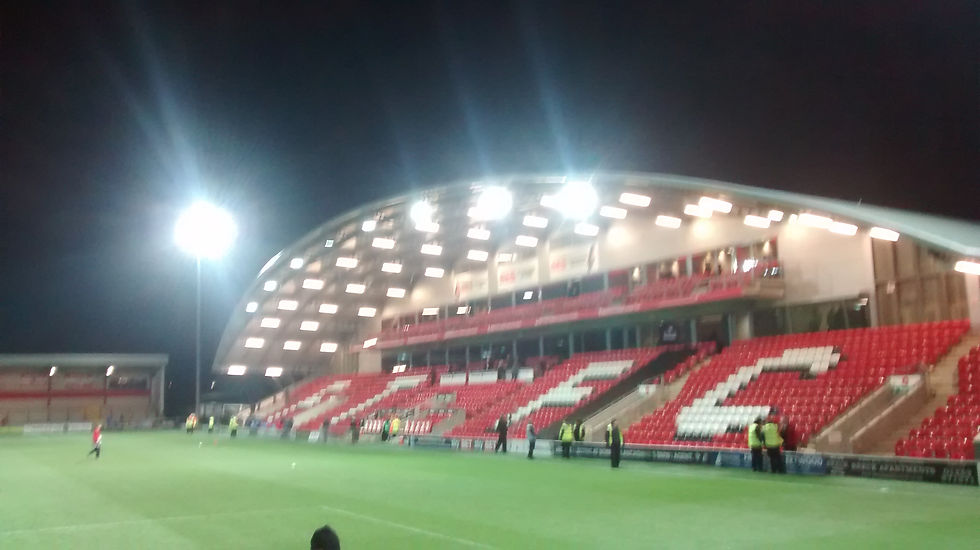
The most eye-catching development came in 2010, when the new Parkside Stand was opened. This stand, situated along one side of the pitch, became the focal point of the modern Highbury. It housed executive boxes, hospitality lounges, and improved seating that gave the club facilities on a scale more familiar to Championship or Premier League clubs than a team that had only just emerged from non-league football. Its opening was a statement of intent. Fleetwood were no longer content to simply exist; they were determined to rise. The Parkside Stand became a symbol of the club’s ambition and gave Highbury a distinctive identity, with its sleek, modern façade standing out in contrast to the surrounding houses of the fishing town.
Other parts of the stadium also evolved. The Memorial Stand behind one goal, named in tribute to those lost at sea from the town’s fishing industry, became the home end and one of the most atmospheric areas of the ground. Packed with passionate supporters on matchdays, it turned Highbury into an intimidating venue for visiting teams. The Highbury Stand, opposite the Parkside Stand, retained more of the ground’s traditional non-league character, with terracing that kept fans close to the action. This blend of old and new gave the stadium a unique charm, mixing modern comfort with the intimacy and raw energy that make smaller grounds special.
Fleetwood’s progress on the pitch accelerated dramatically. In 2005 the club were competing in the North West Counties League, several divisions below the Football League. By 2006 they had gained promotion to the Northern Premier League, and in 2008 they reached the Conference North, a level many supporters had once thought unattainable. Highbury hosted unforgettable nights during this era, with record crowds turning out to see the team take on bigger names and secure crucial promotions. One particularly famous moment came in 2010 when Fleetwood won promotion to the Conference Premier, the highest level of non-league football. Jamie Vardy, who would later rise to international fame with Leicester City and England, played a starring role during this period, scoring prolifically and becoming a cult hero in Fleetwood. Highbury was where Vardy’s story really began, and his exploits added an extra layer of significance to the ground’s history.
In 2011–12, Fleetwood achieved their ultimate dream: promotion to the Football League. Under manager Micky Mellon, they won the Conference Premier title, finishing ahead of Wrexham with an impressive tally of 103 points. Highbury was the epicentre of the celebrations, as thousands of supporters crammed into the stadium to see their small-town team crowned champions of non-league football. Fleetwood’s entry into the Football League was not only historic for the club but also a milestone for the town itself, which could now boast professional league football for the first time.
Highbury, though one of the smallest grounds in League Two, was more than ready. Thanks to the redevelopment of the Parkside Stand and other improvements, the ground met Football League standards, and its compact size created a unique atmosphere that often-unsettled visiting teams. The record attendance in the modern era came during Fleetwood’s FA Cup tie against Blackpool in 2012, when over 5,000 packed into Highbury to witness a Fylde coast derby that captured the imagination of the town. The intimacy of the ground meant that even attendances of around 3,000 generated noise levels comparable to much larger venues.
Fleetwood’s rise did not stop with their entry into the Football League. In 2013–14, under manager Graham Alexander, the club achieved promotion to League One via the play-offs. The semi-final at Highbury against York City was one of the greatest nights in the stadium’s history, with a packed crowd roaring the team on to Wembley. Fleetwood triumphed at Wembley against Burton Albion, securing promotion to the third tier of English football. For a club that had only reformed in 1997, the achievement was extraordinary. Highbury, once a non-league ground hosting games for a few hundred, was now hosting League One fixtures against former Premier League clubs.
Since then, Highbury has continued to be the scene of memorable matches and steady consolidation. Fleetwood have held their own in League One, recording some strong finishes, including a fourth-place finish in 2016–17 under Uwe Rösler, which saw them narrowly miss out on a place in the Championship. The ground has seen Fleetwood take on giants such as Sheffield United, Sunderland, and Portsmouth, as well as local rivals Blackpool, in fiercely contested derbies that have filled Highbury with passion and noise.
Beyond Fleetwood’s own exploits, Highbury has also hosted other notable events. England youth international matches have been staged at the ground, recognition of the quality of its facilities despite its relatively small size. These occasions brought a taste of international football to the people of Fleetwood and highlighted how far the ground had come since its days as a humble non-league venue.
Future plans for Highbury remain the subject of ongoing discussion. The ground, with its capacity of just over 5,300, is one of the smallest in the Football League. While its atmosphere is a great strength, the limited capacity restricts revenue opportunities and poses questions about long-term growth. Expansion has been considered, particularly around the Memorial Stand, where additional seating could be added, but the club has always taken a cautious approach, wary of repeating the financial overreach that doomed its earlier incarnations. What is clear is that Fleetwood remain committed to developing their facilities in line with their footballing ambitions, ensuring Highbury continues to evolve without losing its community feel.
In terms of achievements, Fleetwood’s story is remarkable. Since reforming in 1997, the club has won numerous promotions, climbing from the tenth tier of English football to the third. Along the way they have collected league titles, play-off victories, and cup triumphs at non-league level. Their crowning achievements remain the Conference Premier title in 2012 and the League Two play-off victory in 2014, both moments when Highbury was at the heart of celebrations that reverberated across the town. Though the club has yet to win major national trophies, its very existence as a Football League side is a triumph in itself, given the repeated financial failures of the past.
Highbury today is a stadium that blends tradition with modernity. Its four stands each tell part of the story: the Parkside Stand symbolising ambition and progress, the Memorial Stand embodying community and heritage, the Percy Ronson Stand reflecting loyalty and service, and the Highbury Stand retaining echoes of the old non-league days. Together they create an arena that is intimate, noisy, and uniquely Fleetwood.
The story of Highbury and Fleetwood Town FC is therefore not just about football but about identity, resilience, and dreams made real. From their formation in 1908, through decades of struggle and rebirth, to their ascent into the Football League, the club and the stadium have walked hand in hand. Highbury has been the constant, bearing witness to failures, triumphs, collapses, and rebirths. It has hosted local derbies, cup shocks, title celebrations, and international youth matches, and it remains the focal point of a proud community. For the people of Fleetwood, Highbury is far more than bricks and mortar; it is a symbol of their spirit, their passion for football, and their belief that even a small fishing town can dream big.


Comments