


Leicester City – King Power Stadium
- Jimmy Muir

- Dec 9, 2025
- 4 min read
Leicester City Football Club, one of England’s most intriguing and storied football institutions, was founded in 1884 under the name Leicester Fosse. The club was formed by a group of former schoolboys from Wyggeston School, and their initial matches were played on a field near Fosse Road, which ultimately lent the club its original name. From these humble beginnings, Leicester Fosse developed quickly, joining the Football Association in 1890 and later turning professional in 1891. The club became a member of the Football League in 1894, entering the Second Division and playing their debut season at that level in 1894–95.

In the early years of its existence, Leicester Fosse played home matches at several grounds. The team initially played at Mill Lane, before moving to Victoria Park, and then Grace Road, a cricket ground which hosted the club until 1891. That year, they moved to Filbert Street, which would go on to serve as their home for the next 111 years. Filbert Street was located in the southern part of the city and became closely associated with the club’s identity. Over the decades, Filbert Street saw a number of expansions and redevelopments, transitioning from a basic field to a more sophisticated stadium, complete with covered stands and seating for tens of thousands of fans. The Main Stand, constructed in the 1920s, became an iconic feature of the ground, and by the 1990s the capacity had grown to over 21,000.
In 1919, following World War I, the club underwent a major transformation. After financial difficulties, Leicester Fosse was reformed as Leicester City Football Club, a change that reflected the newly granted city status to Leicester itself. The club’s colours, royal blue and white, remained, but the rebranding marked a new era. Leicester experienced a number of high and low points throughout the 20th century, often fluctuating between divisions. Their early successes included several promotions to the top flight, but they also suffered multiple relegations.
The 1960s proved to be a golden decade for the Foxes. Under the stewardship of managers like Matt Gillies, the club reached the FA Cup Final twice, in 1961 and 1963, though they lost on both occasions. In 1964, Leicester won the League Cup, securing their first major trophy with a 4–3 aggregate victory over Stoke City. Another League Cup triumph followed in 1997 under Martin O’Neill, who led the club through one of its most successful periods. O’Neill’s Leicester side won two League Cups and maintained a consistent presence in the Premier League, with stars like Emile Heskey, Steve Walsh, and Muzzy Izzet becoming household names.
As football entered the 21st century and stadium requirements evolved, it became clear that Filbert Street was no longer fit for purpose. Limited in terms of expansion and increasingly outdated, the club opted to move to a new purpose-built stadium. The King Power Stadium, originally named the Walkers Stadium after the club’s then-sponsors Walkers Crisps, opened in 2002. Located just 200 yards from Filbert Street, the new stadium had a modern bowl design with an all-seater capacity of 32,500, offering improved facilities for players and fans alike.
The move to the King Power Stadium was both a fresh start and a continuation of Leicester’s proud football heritage. Although the club suffered relegation to League One in 2008—the first time in their history they had dropped to the third tier—resilience defined the club’s resurgence. They returned to the Championship at the first attempt and were back in the Premier League by 2014 under the guidance of Nigel Pearson. That season, Leicester completed a stunning escape from relegation, winning seven of their last nine games.
What followed the next season was a footballing fairy tale. Under Claudio Ranieri, Leicester City achieved the seemingly impossible in 2015–16 by winning the Premier League title. Starting the season as 5000-1 outsiders, the team defied all odds, playing an inspiring brand of counter-attacking football. Jamie Vardy broke the Premier League record for scoring in consecutive matches, Riyad Mahrez dazzled defenders, and N’Golo Kanté controlled the midfield with relentless energy. Leicester’s title triumph remains one of the greatest upsets in sporting history and brought global attention to the club and the city.
The King Power Stadium became a fortress during that unforgettable season, and the club’s Thai ownership, led by Vichai Srivaddhanaprabha, received widespread praise for their stewardship. Vichai’s tragic death in a helicopter crash outside the stadium in 2018 shook the football world, but his legacy lived on through the continued commitment of his son, Aiyawatt. Under Brendan Rodgers, appointed in 2019, the team continued to push for European qualification, and in 2021 they lifted the FA Cup for the first time in their history, defeating Chelsea 1–0 at Wembley thanks to a thunderous long-range strike from Youri Tielemans. That same year, Leicester also won the FA Community Shield.
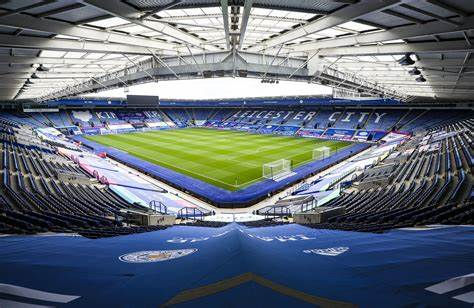
The King Power Stadium has continued to evolve since its opening. Initially built with a single tier around the bowl and corporate boxes along the west stand, the stadium was designed with expansion in mind. The club has since announced ambitious redevelopment plans, including increasing the capacity to around 40,000 by adding an additional tier to the East Stand. These plans, revealed in 2021, also feature proposals for a new club megastore, a hotel, residential buildings, and a state-of-the-art training and leisure complex surrounding the stadium, reflecting the club’s commitment to building on its recent success and investing in its future.
Leicester’s ambitions are not just focused on the domestic game. Participation in European competitions, such as the UEFA Champions League in 2016–17 and the UEFA Europa League and Europa Conference League in subsequent years, has established the club as a rising force in international football. Their quarter-final run in the Champions League included memorable nights against Sevilla and Atlético Madrid, showcasing Leicester’s ability to compete with the continent’s elite.
Throughout its history, Leicester City FC has shown remarkable perseverance and adaptability, often rebounding stronger after setbacks. From their formation as Leicester Fosse to their miraculous Premier League title win, and from Filbert Street to the King Power Stadium, the journey of the Foxes is one of growth, drama, and unyielding ambition. The club’s rich history is matched by a forward-thinking vision, and with their redeveloped stadium on the horizon and a passionate fan base behind them, Leicester City remains a proud emblem of English football’s unpredictability and magic.


Comments