


Liverpool - Anfield
- Jimmy Muir

- Jan 20
- 7 min read
Anfield is one of football’s most evocative places: a patch of terraced housing and cobbled streets in north Liverpool that, for well over a century, has acted as both a crucible of local identity and a global stage for some of the game’s most unforgettable moments. The story of Anfield cannot be separated from the story of Liverpool Football Club; the ground predates the club that made it famous, and its evolution — from a rented field with a wooden stand to a modern, multi-tiered stadium with hospitality suites and high-tech infrastructure — mirrors the social, economic and architectural changes in English football itself. These narrative traces that arc: the origins of the club and its move into the Football League, the different pitches and stands that have occupied the site, the steady programme of redevelopment that has reshaped sightlines and capacities, the major matches and events that gave the place mythic resonance, and the most recent and future developments that define Anfield’s present and near future.
The ground that would become Anfield was first used for organized play in the 1880s. Everton had been playing at Priory Road but needed a new home; John Orrell, a local landowner, allowed Everton to use a parcel of land on what was then a rising suburb north of the city. Everton’s first match at that venue was in September 1884, and by the late 1880s the ground was hosting league fixtures and even international fixtures such as a British Home Championship match in 1889. A dispute over the ownership and running of the ground between Everton’s committee and one of the ground’s leading figures, John Houlding, bubbled up through the early 1890s. The quarrel culminated in Everton leaving Anfield in 1892 to move across Stanley Park to Goodison Park; Houlding, left with a perfectly serviceable ground and no team to occupy it, founded a new club to fill the void. That new club — Liverpool Football Club, formally constituted in 1892 — began playing at Anfield immediately. Liverpool won the Lancashire League in its opening season and were accepted into the Football League’s Second Division for the 1893–94 season, establishing the connection between club and stadium that continues to this day.

In its Victorian and Edwardian years, Anfield’s fabric reflected the piecemeal economics of early football grounds. Stands were small, often timber-framed or simply earthen embankments with wooden terraces; turnstiles and small clubhouses sat close to terraced houses, and the relationship between club and neighbourhood was intimate. One of the defining features to emerge in the early twentieth century was the Kop: a single-tier embankment at the end of the ground that, after redevelopment and naming in 1906, would become the spiritual heart of Anfield. Named after the Battle of Spion Kop in South Africa, the Kop was famed for its dense, single-tier atmosphere and its capacity to hold tens of thousands of supporters in a single bank of terracing; at its peak it could hold more people than many full grounds elsewhere. The Kop and other stands — including the Main Stand and the Anfield Road Stand — were gradually improved with concrete and steel over the decades, yet the ground retained a patchwork, organic quality that marked many British grounds of the period.
Anfield’s mid-century profile was dramatically illustrated by attendance figures that now read like relics of a bygone era. Record crowds were common in the 1940s and 1950s when standing terraces allowed vast numbers to press close to the action; the highest sporting attendance ever recorded at Anfield was 61,905 for an FA Cup tie against Wolverhampton Wanderers in February 1952, a figure that still stands as the ground’s peak sporting crowd and a reminder of how capacious terraces once were. That era of mass standing crowds, however, would be transformed by the safety movements and regulations that followed stadium disasters in the 1980s and early 1990s; the Taylor Report after Hillsborough in 1989, in particular, fundamentally reshaped stadium design in the United Kingdom by pressing for all-seater stadia and improved safety infrastructure, and Anfield’s capacity and interior arrangements were subsequently altered to comply with the new regulatory and comfort standards.
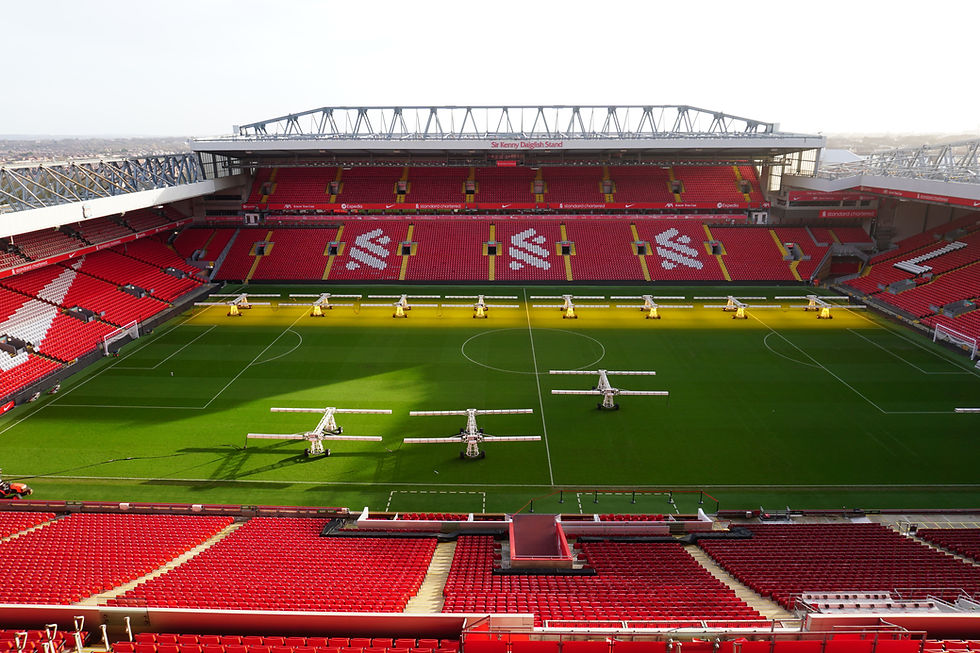
Anfield has hosted many moments beyond Liverpool’s own matches that have stamped its importance on wider sporting history. The ground was a venue for UEFA Euro 1996, staging group games and a quarter-final, and for decades it was used for England internationals and for other national sides, particularly Wales in later decades; in the nineteenth and early twentieth centuries Anfield even staged British Home Championship fixtures. The close proximity of the stands to the touchlines — which so many fans prize for intimacy and noise — has at times proven a limiting factor when it comes to the pitch dimensions required for the most exacting UEFA and FIFA finals. That quirk of geometry, alongside the modern technical demands for hospitality and media spaces, means that while Anfield routinely hosts high-profile club and international friendlies, it is not always the venue chosen for the largest UEFA tournament fixtures in the contemporary era. Anfield has also been the site of FA Cup semi-finals, memorable European nights under floodlights, and contemporary domestic showdowns whose atmosphere has been replayed in documentaries and highlight reels for decades.
The ground has, increasingly, been used as a cultural space as well as a sporting one. A new generation has seen Anfield play host to major concerts and civic events that attract audiences who might never come for a Saturday kick-off. In June 2024, for example, global superstar Taylor Swift performed multiple nights at Anfield to crowds in excess of 60,000 for each show, an event that drew significant national attention and local economic activity and which some reports described as surpassing earlier attendance benchmark figures. Concerts of that size underline both how stadiums have become multi-purpose arenas for culture as well as sport and how modern ground upgrades have allowed Anfield to handle very large non-sporting crowds while still maintaining safety standards and neighbourhood relationships. That blending of uses — sports, music, commemoration — is part of what defines modern stadium life.

While Anfield’s physical fabric has been central to its story, the moments on the pitch and the honours accumulated by Liverpool FC are the other half of the ground’s myth. Liverpool has been one of English and European football’s most successful clubs: a long list of league championships, FA Cup and League Cup wins, and a global record in European competitions have all been celebrated within the stadium’s walls. The club’s European pedigree, including six European Cup/UEFA Champions League victories and multiple UEFA Cup and UEFA Super Cup successes, has brought night-after-night continental drama to Anfield; the songs and banners that rose under floodlights after famous European nights are part of the place’s DNA. More recently, domestic triumphs — including Premier League titles — have been secured and celebrated in the stadium: the club’s return to the very top of English football in 2019 (winning the Champions League that year and the Premier League in 2019–20) and subsequent domestic successes have ensured that the trophy lift at Anfield has remained one of the most cherished images in modern English football. As of the mid-2020s Liverpool’s honours list runs to dozens of major trophies across domestic and international competitions, a quantitative testament to the club’s enduring competitiveness and cultural reach.

Anfield’s history is also textured by moments of solemn remembrance and communal responsibility. Liverpool’s identity has been bound up with the city’s industries, its tragedies and its solidarities — on occasion symbolised in memorials and commemorative acts at the stadium itself. In the spring of 2025, the club worked with victims’ families and partner clubs to unveil a new memorial at Anfield to remember the victims of the Heysel Stadium disaster of 1985, marking decades of remembrance and emphasising the club’s commitment to acknowledging the past as part of the ground’s modern role. Such gestures — while not altering the stadium’s steel and concrete — remind supporters and visitors that Anfield is a civic space as much as a commercial venue.
The future of Anfield is likely to be shaped by a few overlapping vectors: the search for marginal gains in capacity and matchday revenue; continuing attention to sustainability and neighbourhood impact; and the desire to preserve the essential matchday atmosphere that makes Anfield special. With the Main Stand and Anfield Road redevelopments largely complete, the club has signalled that future work will prioritize improving the fan experience, corporate and hospitality infrastructure, and transport links rather than full-scale increases in capacity beyond the 61,000 mark. That is partly practical — the stadium sits in a dense residential area where expansion is tightly controlled — and partly strategic: recent changes have already brought the ground close to its historical peak capacity while leaving the Kop intact as a single-tier singing stand, a feature many fans and traditionalists consider non-negotiable. Meanwhile, broader trends in stadium design — sustainability measures, flexible-use spaces, improved accessibility, and investment in community facilities — mean that Anfield’s next projects will probably be judged as much on environmental and social criteria as on ticket numbers. FSG and the club have been explicit in the past about balancing commercial imperatives with community responsibilities; in practice that means incremental, targeted investment rather than wholesale relocation.
Important matches and moments at Anfield are too numerous to catalogue exhaustively, but a few exemplify the stadium’s layered meaning. The great European nights — when Liverpool would overturn seemingly impossible deficits or grind out victories against continental giants — are part of football lore. The long, loyal sequences of home unbeaten runs, periods when the Kop roared teams into submission, and the shared griefs and joys of the fanbase have all made Anfield a repository of memory. Historic league titles and cup finals have been punctuated by quieter but equally meaningful events — club centenaries, manager appointments and departures, and the rituals of memorial and tribute that take place in the stadium concourses. The 1952 FA Cup crowd remains a statistical high-water mark; the twentieth and twenty-first century improvements — including the 1992 Main Stand centenary works, the 2016 Main Stand enlargement, and the Anfield Road expansion that pushed capacity over 61,000 — mark the stadium’s transformation from a Victorian ground to a twenty-first-century venue for sport and spectacle.
If Anfield’s stones and terraces could speak, they would tell a story of continuity and change: a ground that began as a local pitch and became the epicentre of a global sporting brand; a place where social history and sport meet; and a site that must now reconcile heritage with the demands of modern stadia economics and safety. For the fan who walks up Anfield Road on a matchday the experience still has an old-fashioned immediacy — the red shirts, the chants, the Kop’s thunderous presence — yet the stadium around them has screens, corporate boxes and hospitality clusters that would have been unimaginable in the 1880s. That tension — between the old and the new — is what gives Anfield its particular charge. It is a stadium that remembers its past while continually remaking itself to meet the requirements of the present and the future.


Comments