


Manchester United – Old Trafford
- Jimmy Muir

- Oct 15, 2025
- 5 min read
Manchester United Football Club, one of the most globally recognised sporting institutions, traces its origins to the industrial heart of England in the late 19th century. The club began life in 1878 as Newton Heath LYR Football Club, a team formed by workers from the Lancashire and Yorkshire Railway depot. Playing initially in green and gold colours, Newton Heath competed in regional leagues before joining the Football Alliance in 1889. The club was admitted into the Football League in 1892 and soon faced severe financial struggles. On the brink of collapse in 1902, Newton Heath was saved by local brewer John Henry Davies, who invested £500 and reorganised the club under a new name: Manchester United.
During their early years, Newton Heath played at North Road in Newton Heath from 1878 to 1893. The facilities were basic and often criticised, with no proper stands or spectator shelters. In 1893, the club moved to Bank Street in Clayton, where conditions improved slightly but remained far from ideal. The pitch was often muddy and surrounded by little more than wooden barriers. As Manchester United gained prominence under their new name and colours, it became evident that a new, more substantial stadium would be required to reflect their growing ambitions.
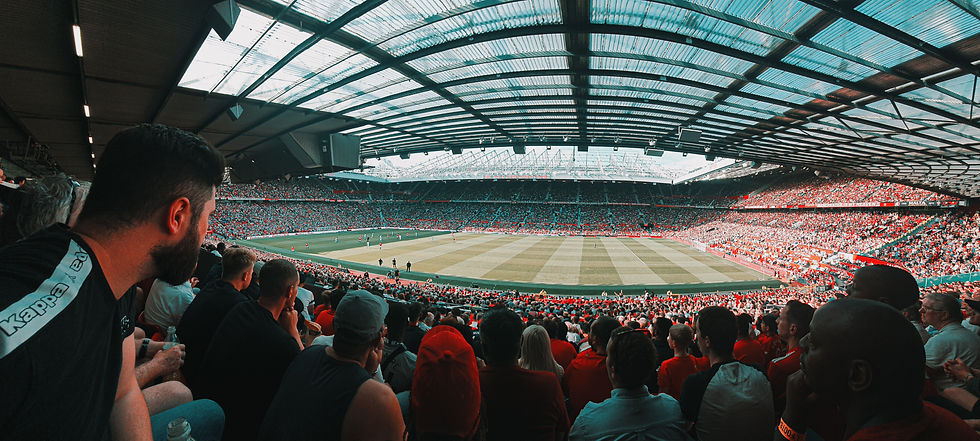
The solution came in the form of a bold vision by club chairman John Henry Davies and club secretary Ernest Mangnall. Land was acquired in Old Trafford, Stretford, and renowned stadium architect Archibald Leitch was commissioned to design a new ground. Construction began in 1908, and on 19 February 1910, Old Trafford officially opened its gates for the first time with a match against Liverpool. Though Manchester United lost 4–3, the new ground made a powerful impression with its capacity of 80,000 and innovative cantilever roof design on the main stand. It was quickly nicknamed “The Theatre of Dreams,” a term later popularised by Sir Bobby Charlton.
The early years at Old Trafford were promising for the club, with United securing their second league title in 1911, having won their first in 1908. However, the coming decades would bring disruption, including two World Wars that deeply affected the nation and the club. During the Second World War, Old Trafford suffered significant damage from a German bombing raid in March 1941. The stadium’s Main Stand was destroyed, and the club was forced to play its home matches at Manchester City’s Maine Road while repairs were carried out. United paid rent to their neighbours until Old Trafford was rebuilt, with the help of war compensation funds, and reopened in 1949.

The post-war era saw the rise of a legendary figure who would define Manchester United for generations: Sir Matt Busby. Appointed in 1945, Busby revolutionised the club with a focus on youth development and attacking football. Under his guidance, the “Busby Babes” emerged in the 1950s as a formidable young team. They won back-to-back league titles in 1956 and 1957, with Old Trafford regularly hosting huge crowds in excess of 60,000. Tragedy struck on 6 February 1958 when eight players lost their lives in the Munich Air Disaster. The crash devastated the club, but Busby miraculously rebuilt the team, leading United to their greatest triumph in 1968 when they became the first English club to win the European Cup, defeating Benfica 4–1 at Wembley.
Old Trafford continued to evolve, with various redevelopment phases undertaken to modernise the stadium. In the 1960s and 1970s, roofs were added to previously uncovered stands, and the ground began to adopt more all-seater arrangements. Floodlights were installed in the 1950s, and executive boxes appeared in the 1980s as football began its shift toward commercialisation. Despite domestic cup success and occasional strong league finishes, Manchester United went 26 years without a league title following 1967, until the arrival of a manager who would define the modern era: Sir Alex Ferguson.

Appointed in 1986, Ferguson initially struggled but was famously given time to build his team. Victory in the FA Cup in 1990 proved to be a turning point. In 1992–93, Manchester United won the inaugural Premier League title, their first league triumph since 1967. This victory was the beginning of an era of unprecedented dominance. Under Ferguson, the club won 13 Premier League titles, five FA Cups, four League Cups, and two UEFA Champions League titles, including the dramatic 1999 treble in which United captured the league, FA Cup, and European Cup. That same year, they defeated Bayern Munich 2–1 at the Nou Camp in one of football’s most extraordinary comebacks, with goals from Teddy Sheringham and Ole Gunnar Solskjær in stoppage time.
As Ferguson’s success grew, so did Old Trafford. To accommodate a surging fanbase, the stadium underwent extensive expansion. Between 1995 and 2006, the North, East, and West Stands were redeveloped into towering three-tier structures. These expansions increased Old Trafford’s capacity to approximately 76,000, making it the largest club football stadium in the United Kingdom. The South Stand, named after Sir Bobby Charlton, remains smaller due to the proximity of the adjacent railway line, but proposals for future redevelopment are ongoing and could eventually see the capacity rise to over 90,000.
The stadium has played host to a wide range of significant footballing events beyond Manchester United fixtures. Old Trafford was one of the venues used during the 1966 FIFA World Cup, although it did not host matches due to its ongoing renovation at the time. More recently, it played a prominent role during the UEFA Euro 1996 tournament in England, hosting several matches including a semi-final. During the 2012 Summer Olympics, it served as a key football venue, including for women's international fixtures. It has also hosted FA Cup semi-finals, England internationals, and Rugby League World Cup finals.
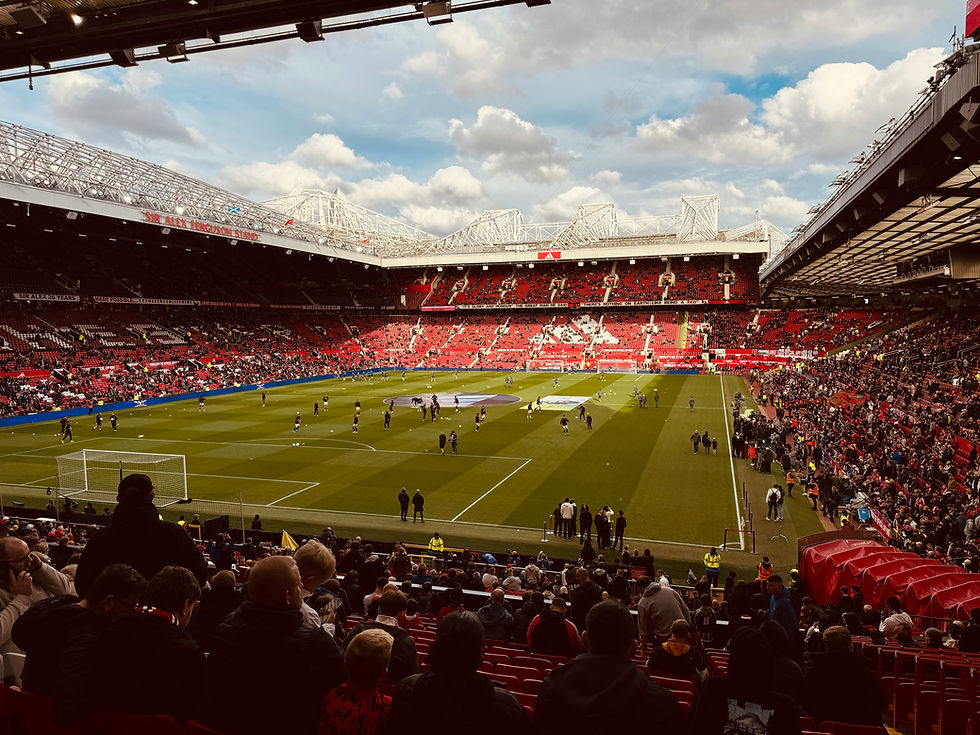
The record attendance at Old Trafford stands at 76,962, set during a Premier League match between Manchester United and Blackburn Rovers on 31 March 2007. While the stadium has evolved into a modern arena, it retains much of its original character and remains deeply woven into the identity of the club and its supporters. The iconic players' tunnel, the Stretford End, and the Sir Alex Ferguson Stand all serve as tributes to the individuals and moments that have shaped the club’s illustrious history.
Manchester United’s achievements are unmatched in many respects. The club has won a record 20 English league titles, 12 FA Cups, six League Cups, and three UEFA Champions League trophies. They have also lifted the FIFA Club World Cup and the UEFA Europa League, further cementing their place in the global pantheon of elite football clubs. The Busby Babes, the Class of ’92, and countless legends including George Best, Eric Cantona, Ryan Giggs, Paul Scholes, Cristiano Ronaldo, Wayne Rooney, and many more have left an indelible mark on the game.
Ownership changes and the evolution of football finance have affected Manchester United in the 21st century, with the Glazer family acquiring the club in 2005 in a leveraged buyout that provoked widespread protest among fans. The stadium, though upgraded significantly since the 1990s, has more recently been criticised for needing modernisation in comparison to rivals across Europe. Leaks, outdated infrastructure, and concerns over crowd management have prompted discussions about a major renovation or even building a brand-new stadium on adjacent land. As of 2025, no concrete plan has been approved, but fan pressure and club ambition suggest that Old Trafford will either undergo a substantial redevelopment or be replaced by a world-class new ground in the coming decade.
Despite these uncertainties, Old Trafford remains one of the most iconic venues in world football. It stands as a monument to over a century of sporting history, resilience, and triumph. From the ashes of wartime destruction to the heights of European glory, the stadium has borne witness to the best and worst of Manchester United. As new generations of players and supporters emerge, and as the club seeks to reclaim its place at the summit of English and European football, Old Trafford endures as the heart of the Red Devils—an arena where dreams have been made, legends have been born, and history continues to be written.


Comments