


Stevenage - Broadhall Way
- Jimmy Muir

- Nov 25, 2025
- 9 min read
Broadhall Way sits where the modern town of Stevenage meets its post-war ambitions: a compact, red-and-white enclave of terraces, stands and clubrooms that, for more than half a century, has been the physical and emotional home of football in the town. The ground—known to supporters today as the Lamex Stadium for sponsorship reasons—has worn many faces and seen many fortunes. It has watched local teams rise and fall, been the site of dramatic cup nights and record crowds, and ultimately played a decisive part in Stevenage Football Club’s transformation from a community side into a club with a place in the English Football League. The story of Broadhall Way is both the story of a town making a stadium its own and of a club repeatedly adapting its ground to meet the demands of progress and opportunity.
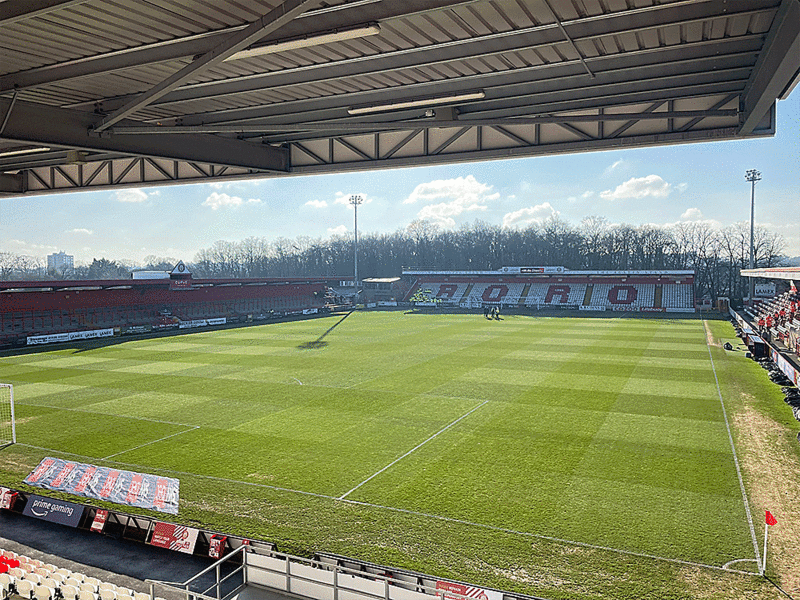
Organised football in Stevenage predates Broadhall Way by many decades. The town’s earliest recorded matches were played on London Road—once the sporting heartland of a small Hertfordshire market town—where football and cricket shared the facilities that were common in late Victorian and Edwardian England. The modern municipal ground on Broadhall Way was constructed in the early 1960s; the site was previously part of the town’s green spaces and leisure provision and was adapted to provide dedicated football facilities as the town expanded. Broadhall Way opened for football in 1961 and initially hosted Stevenage Town, a local side that drew modest crowds and provided the foundations for the town’s football culture. Those early years were typical of lower-league and non-league grounds of the period: a mixture of terracing, a simple seated main stand, changing rooms built for utility rather than comfort, and a pitch that could be susceptible to the winter weather.
The ground’s early decades were marked by starts and stops. After Stevenage Town, the ground became home to Stevenage Athletic, a separate club that carried the town’s hopes through the late 1960s and early 1970s; financial struggles and the cyclical fragility of semi-professional football led to the Athletic club’s demise in 1976. The stadium itself fell into disuse for a few years until the formation of a new senior club, Stevenage Borough, in 1976 (later shortened to Stevenage F.C.). The local council played a critical role: the authority re-purchased and refurbished Broadhall Way to ensure a home for the new club. That intervention was pivotal—what might have become an abandoned municipal site instead became the base for a team with renewed ambitions and community backing. From 1980 onwards, Broadhall Way steadily settled into its role as the town’s principal sporting venue.
Physically, Broadhall Way evolved in stages rather than in one sweeping build. The ground’s original configuration in the 1960s and 1970s was dominated by open terraces and a modest main stand. The 1990s and early 2000s brought the first serious programme of modernisation, driven in part by on-field success that demanded off-field improvements. In the mid-1990s, Stevenage Borough won the Football Conference (the top level of non-league football) but were denied promotion to the Football League because Broadhall Way did not meet the Football League’s ground standards at that time; the episode reinforced the growing understanding that the club’s ambitions and its stadium’s capacity and facilities had to be aligned. Over the next decade the ground saw incremental but meaningful investment: terraces were replaced or roofed, hospitality and executive facilities were added under new stands, and seating was increased to satisfy ground-grading requirements. A notable development in the early 2000s was the construction of a substantial South Stand which incorporated executive suites and media facilities—an investment that signalled the club’s intention to make Broadhall Way a modern, commercially viable stadium.
The often dramatic nights that happen in cup football have etched themselves into Broadhall Way’s collective memory. The club’s FA Cup adventures in the 1990s and 2000s produced some of the stadium’s most electric moments—perhaps none more so than the fourth-round tie against Newcastle United in January 1998, when Broadhall Way accommodated its record crowd. Anticipating demand, a temporary stand was erected and the attendance for that match was officially recorded as 8,040, the highest number ever to watch football within the ground’s boundary. The match—an FA Cup fourth-round tie that ended 1–1—was emblematic of how a modest non-league stadium could, for a single night, feel like the centre of English football. That single event has been the benchmark against which the ground’s capacity and crowd potential are often judged.
Alongside headline cup nights, Broadhall Way’s role as a regional sporting venue has also seen it host youth internationals, reserve fixtures for top-flight sides, and community events. Tottenham Hotspur, for example, have used the ground for under-21 and reserve fixtures at various points—an arrangement that underscores the ground’s suitability for competitive fixtures beyond the first team and its integration into wider footballing networks. Such matches deliver revenue and profile to a smaller club and bring a different kind of football to local supporters, while providing visiting clubs with a useful nearby neutral or developmental venue.
The ground’s commercial identity shifted in January 2009 when Stevenage agreed a significant sponsorship deal with the Lamex Food Group and the stadium took on the company’s name, becoming the Lamex Stadium. The naming rights deal was an important commercial milestone for the club. It reflected both the increasing necessity for clubs outside the top tiers to diversify income and the willingness of local business to invest in the club’s future. While some fans are resistant to corporate renaming, the Lamex partnership brought financial stability that helped fund further stadium improvements and community projects attached to the club’s development plans.
On the pitch, the years immediately surrounding the turn of the century represented a golden period for Stevenage—both in terms of results and reputation—and Broadhall Way was central to that story. The club lifted the FA Trophy in 2007 in a dramatic comeback against Kidderminster Harriers, a final that holds particular historical notice as the first competitive match played at the new Wembley Stadium and one that saw Stevenage captain Ronnie Henry become the first man to lift a competitive trophy at the rebuilt national arena. The club won the FA Trophy again in 2009, underlining Stevenage’s status as one of non-league football’s leading sides at that time and attracting large travelling followings to Wembley. Domestically, the club’s on-field successes culminated in the 2009–10 season when Stevenage Borough won the Conference Premier title and gained promotion to the Football League for the first time in the club’s history. That championship run ended a long chapter of non-league life and demanded further stadium compliance with Football League standards.
Entry into the Football League in 2010 was a turning point. Broadhall Way—small, sometimes intimate, and never designed for the modern commercial gauntlet—was suddenly a League ground. The first League match at Broadhall Way took place in August 2010 and was an occasion that mixed excitement with the practical challenges of infrastructure: ticketing, stewarding and media had to operate within higher expectations, and the club’s back office had to adapt to the requirements of the English Football League. The promotion also changed supporter demographics, brought increased away support, and required the club to think strategically about capacity and accessibility. Over the next decade the club balanced maintaining the stadium’s familiar atmosphere with upgrading facilities to keep pace with both regulatory obligations and supporter expectations.
A distinct phase of redevelopment arrived in the 2010s and culminated with work on the north end of the ground. Planning permissions and community investment were marshalled to replace the aging North Terrace with a modern, two-tiered seated stand that would increase the stadium’s seated capacity and add corporate, conference and medical facilities. The scheme was deliberately multi-functional: by combining matchday seating with off-pitch revenue generators—executive boxes, conference rooms and event spaces—the club aimed to make the stadium financially sustainable throughout the year, not just on matchdays. A successful community financing drive, together with traditional funding streams and local business support, helped close funding gaps and the new North Stand opened in late 2019, pushing the ground’s capacity up (estimates vary depending on configuration) and offering improved sightlines, better disabled access and more modern concessions and toilet facilities. The redevelopment was also part of a broader local regeneration conversation: Stevenage town centre planning and ‘Stevenage Even Better’ initiatives have recognised the role of the football club and its stadium in the town’s civic life and economic activity.
Even with these improvements, Broadhall Way is deliberately modest when compared to large Football League venues. Its character is defined by tight sightlines, a closeness between stands and pitch that creates noise, and the small-town football rituals that survive at the scale of a seven- or eight-thousand capacity ground. For players, the ground’s intimacy can be intimidating for visiting sides; for local supporters it offers familiarity and identity. That identity has been carefully tended: the club’s heritage displays, the 1976 bar, the club museum and matchday rituals are part of a deliberate effort to ensure that stadium modernisation does not erase memory. The balance between comfort and tradition is one that many community clubs seek; Stevenage’s management have repeatedly emphasised that upgrade programmes will be incremental and fan-sensitive, rather than wholesale rebuilds that wipe out the matchday soul.
Broadhall Way has seen many high points of achievement that feed into the town’s pride. Beyond FA Trophy triumphs and promotion to the Football League, the club’s first season in the League produced further success: Stevenage consolidated quickly, and in 2011 achieved a remarkable back-to-back promotion by winning the League Two play-offs to reach League One for the first time. That run of rapid progress—Cup finals at Wembley, ascent through the pyramid and the experience of League football—placed Broadhall Way in the national narrative as a small ground producing nationally-recognised football stories. The stadium itself, once criticised in the 1990s for not meeting certain criteria, had become the platform from which the club’s aspirations were realised.
The stadium’s biggest single-match crowd—8,040 against Newcastle United in January 1998—stands as a reminder of what Broadhall Way can do when the footballing cosmos aligns: a big club, a dreamy cup tie and a town ready to host visitors in numbers. That figure exceeded the ground’s nominal capacity at the time and required temporary infrastructure; it is still cited as the ground record and is invoked each time discussions about capacity expansion and planning are reopened. For all its modernisation, Broadhall Way remains constrained by its urban setting and by planning considerations, so capacity enhancements are often about quality (more seats, improved accessibility, better corporate facilities) rather than simply chasing ever larger crowds.
Looking forward, Broadhall Way’s future has been shaped by two linked threads: the club’s ambition to improve matchday experience and commercial viability, and the town’s wider regeneration ambitions which frame the stadium as part of a civic asset rather than an isolated sporting facility. The North Stand project completed in 2019 was a key milestone towards a broader masterplan that envisages incremental stadium enhancements coupled with community and leisure developments. Proposals that have surfaced—some contingent on wider local regeneration schemes—include further refinement of hospitality spaces, improved spectator flow and accessibility works, potential enhancements to training and community outreach facilities, and continued attention to hybrid pitch technologies to lengthen playing season availability. Importantly, the club has tended to prefer phased investment that can be absorbed financially and socially by fans rather than speculative wholesale redevelopments that risk alienating the existing supporter base. Local council plans for Stevenage town centre regeneration also mean that the stadium’s evolution will be discussed in the context of transport, housing and commercial development—a reality that both complicates and enriches planning possibilities.
Broadhall Way’s history is inseparable from the people who built, maintained and supported it. Volunteers, backroom staff, local councillors and generations of fans have shaped the ground’s life: erecting stands, painting fascias, running club shops and stewarding matches. That human capital is especially visible in community initiatives where the stadium hosts local events, youth development and outreach programmes. For many supporters, attending a match at Broadhall Way is as much about the social ritual—pubs, pre-match conversations, the club shop and the familiar faces in the turnstiles—as it is about the ninety minutes on the pitch. The club has tried to preserve those rituals even as it modernises the stadium, recognising that the matchday experience is a cultural product as much as a commercial one.
No stadium remains unchanged forever, and Broadhall Way continues to adapt. Its history records a steady negotiation between what is possible—finance, planning, the physical constraints of the site—and what is desirable: good sightlines, safe and comfortable seating, revenue streams that can support player recruitment and youth development. While Broadhall Way will never be a Wembley or an Old Trafford, its significance is different and no less real: it is the stadium of a town that built a club to carry its name into the national leagues, a ground that hosted the first competitive winners’ presentation at the new Wembley, and a place where an FA Cup night in 1998 is still recounted with a spark. As Stevenage continues to plot its future—on the field and in the town—the stadium will remain both a canvas for ambition and a container for memory, hosting the next generation of dramatic nights, community events and seasons that shape the club’s identity.
In short, Broadhall Way’s story is one of resilient adaptation. From London Road’s Victorian kickabouts to Broadhall Way’s terraces and executive suites, the ground has reflected the changing face of English football while sustaining a local, participatory culture. It has been a staging ground for silverware—the FA Trophy in 2007 and 2009—an arena for historic cup nights that attracted record crowds, and a living project of continual redevelopment driven by fans, local business and civic partners. This is a stadium where history sits alongside progress: the terraces of yesterday shoulder the corporate boxes of today, and in that juxtaposition lies the unique character of Stevenage’s ground—compact, community-rooted and quietly ambitious.


Comments