


Stoke City – bet365 Stadium
- Jimmy Muir

- Dec 10, 2025
- 5 min read
Stoke City Football Club, one of the oldest professional football clubs in the world, traces its origins back to 1863, when it was founded by former pupils of Charterhouse School. The club was originally known as Stoke Ramblers, before adopting the name Stoke Football Club in 1878. The moniker “City” was added in 1925 following the granting of city status to Stoke-on-Trent. Stoke were among the twelve founding members of the Football League in 1888, an honour shared by only a handful of historic clubs, placing them at the very heart of the development of the modern English game. Despite periods of relegation and promotion throughout their history, the club’s roots run deep in the annals of English football.
In the early years, the club played their matches at a number of temporary grounds, the most notable being the Victoria Ground, which became the club’s permanent home in 1878. Located in the Boothen area of Stoke-on-Trent, the Victoria Ground would serve as Stoke’s base for over a century. It underwent several redevelopments over the years to accommodate the evolving demands of professional football. The ground initially featured modest facilities, but by the early 20th century had been expanded to include a main stand and terraced areas, with a capacity that grew to over 50,000 at its peak. The Victoria Ground was a traditional English football ground, with a fierce and loyal fanbase known for creating an intimidating atmosphere for visiting teams. The Boothen End in particular became legendary for its noise and passion.
The post-war years saw Stoke City hover between the First and Second Divisions, never quite establishing a consistent foothold in the top flight. However, the club’s fortunes improved dramatically in the 1960s under the stewardship of Tony Waddington, who brought club legend Stanley Matthews back to Stoke in 1961. Matthews’ return, aged 46, was a masterstroke that reinvigorated the club and its supporters. Waddington’s side earned promotion to the First Division in 1963 and remained there for much of the next decade, producing some of the most entertaining football in the country. The crowning achievement of this era came in 1972 when Stoke City lifted the Football League Cup – the club’s first and only major trophy to date – with a 2-1 victory over Chelsea at Wembley. That team, featuring the likes of Gordon Banks, Alan Bloor, Mike Pejic, and Jimmy Greenhoff, etched their names into Stoke folklore.
Despite moments of brilliance, the late 1970s and 1980s were difficult years, marked by relegations and financial struggles. By the early 1990s, the Victoria Ground was beginning to show its age. The publication of the Taylor Report in the aftermath of the Hillsborough disaster in 1989 led to sweeping changes in stadium safety regulations. All-seater stadia became mandatory for top-flight clubs, which forced many teams to either significantly redevelop their existing grounds or move entirely. Stoke City, then pushing for a return to the top tiers of English football, opted to construct a brand new stadium. The Victoria Ground hosted its final match in 1997, a 2-1 win over West Bromwich Albion, bringing an emotional end to a 119-year chapter of the club’s history.
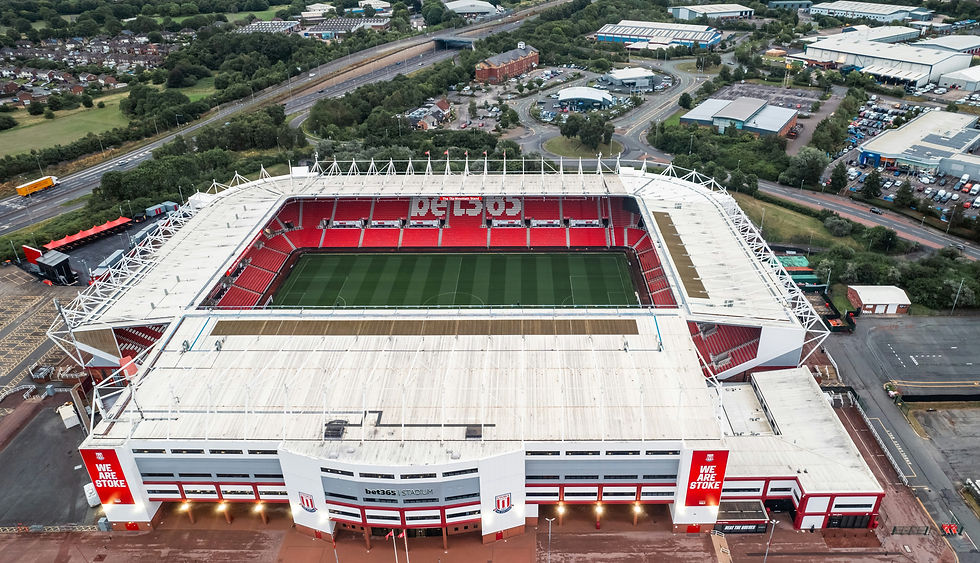
That same year, Stoke City moved into their new home – initially called the Britannia Stadium – built at a cost of approximately £14.7 million on the site of a former colliery in the Trentham Lakes area of the city. The stadium was constructed in a bowl-shaped design with a seating capacity of around 28,000, making it one of the more modern facilities outside the Premier League at the time. The move marked a significant moment in the club’s evolution, ushering in a new era of ambition and professionalism. The Britannia Stadium retained a strong sense of identity, with one stand – the Boothen End – named in homage to the old Victoria Ground. It was also noted for its exposed location atop a hill, which often resulted in swirling winds and challenging conditions for visiting teams.
The club’s fortunes remained mixed in the early years at the Britannia. A period of decline saw Stoke relegated to the third tier of English football by the turn of the millennium. However, under the ownership of local businessman Peter Coates, who returned to take charge of the club in 2006, a new sense of stability and purpose began to take shape. Manager Tony Pulis, appointed in 2006 for a second spell, guided the club to promotion to the Premier League in the 2007-08 season, ending a 23-year absence from the top flight. Stoke City’s first season in the Premier League (2008-09) was marked by resilience and a strong home record, with the Britannia Stadium quickly developing a reputation as a fortress where even the top clubs struggled to win.
Stoke City enjoyed a ten-year stint in the Premier League, consolidating their position in the top flight with strong league finishes under Pulis and later under Mark Hughes. The club’s style of play evolved from the physical, direct approach associated with Pulis to a more expansive brand of football under Hughes. During this era, Stoke attracted high-profile players such as Marko Arnautović, Xherdan Shaqiri, and Bojan Krkić. One of the most memorable moments came in 2011 when the club reached the FA Cup Final, only the second major final in their history. Though they lost 1-0 to Manchester City, their run included a remarkable 5-0 semi-final win over Bolton Wanderers, one of the most dominant performances seen at the new Wembley Stadium. That same season, Stoke qualified for the UEFA Europa League and reached the round of 32, where they were eliminated by Valencia.
The stadium, renamed the bet365 Stadium in 2016 to reflect the club’s association with the online betting company owned by the Coates family, has continued to evolve. The most notable change in recent years was the filling in of the south-east corner in 2017, increasing the capacity slightly and improving atmosphere and facilities. The club has announced intentions to continue developing the stadium and surrounding area, with long-term plans that include further corner infills, expansion of the training complex, and enhanced matchday amenities for supporters. These projects are intended to ensure that the bet365 Stadium remains fit for purpose and continues to reflect the club’s aspirations.
After their relegation from the Premier League in 2018, Stoke City entered a period of rebuilding, cycling through several managers as they sought to stabilise in the Championship. The club’s commitment to its academy, investment in infrastructure, and community outreach has been evident throughout this period, with the bet365 Stadium serving as a central hub not only for football but also for civic engagement and regional pride. Stoke-on-Trent, a city with a strong industrial heritage, continues to see its football club as a cultural touchstone, uniting generations of fans.
While Stoke City’s major silverware remains limited – with the 1972 League Cup the club’s only major trophy to date – they have been runners-up in both the FA Cup (2011) and the League Cup (1964). They’ve also enjoyed several promotions and have produced or developed notable players, including Sir Stanley Matthews, widely regarded as one of the greatest English players of all time, and Gordon Banks, England’s World Cup-winning goalkeeper in 1966. The club’s influence on the English game is further underscored by their status as a founding member of the Football League, a distinction that places them among the sport’s aristocracy.
The legacy of Stoke City Football Club is one of perseverance, deep community roots, and a rich tapestry of football history that spans more than 160 years. From the humble beginnings at the Victoria Ground to the state-of-the-art facilities at the bet365 Stadium, the club has weathered the highs and lows of professional sport while retaining its identity and fiercely loyal support. With plans to further modernise their ground and return to the Premier League, Stoke City continues to build on its proud tradition – one that has left an indelible mark on English football.


Comments