


Tranmere Rovers – Prenton Park
- Jimmy Muir

- Dec 8, 2025
- 5 min read
Prenton Park, the historic home of Tranmere Rovers Football Club, stands as one of English football's enduring institutions on the Wirral Peninsula. The club, founded in 1884 as Belmont Football Club, changed its name to Tranmere Rovers a year later and steadily grew into a respected force in Merseyside football. Tranmere initially played their early games on a number of rudimentary pitches and open spaces, including Steele’s Field, before settling at Ravenshaw’s Field. However, these grounds were basic and lacked the facilities and scale needed for a growing club.
In 1912, Tranmere Rovers moved to Prenton Park, a purpose-built stadium named after the local area. Though this would come to define the club's long-term identity, it was not the first location to bear that name. An earlier “Prenton Park” was used prior to 1912, but the modern ground, located on Borough Road, became their spiritual and physical home. When the club arrived at the new site, the facilities were modest, but they offered the potential for expansion. As Tranmere’s ambitions grew, so too did the stadium, undergoing a series of developments through the 20th century to bring it up to Football League standards.
Tranmere Rovers were elected to the Football League in 1921 when the Third Division North was created, and they became one of its founding members. This pivotal moment marked the club’s arrival on the national stage and solidified its professional status. From that point, Prenton Park became the backdrop to many memorable occasions, hosting thousands of supporters from Merseyside and beyond. The stadium steadily developed over the decades, particularly after World War II, as football attendances boomed across the country.
The 1950s saw the club make efforts to modernise their ground. Floodlights were installed in 1958, and their first match under the lights came against Wrexham. Like many grounds of its era, Prenton Park had terracing and a traditional main stand that offered an intimate atmosphere and strong home support. At its peak, the ground’s capacity exceeded 24,000. In 1972, the stadium set its all-time attendance record when 24,424 fans crammed into the ground to see an FA Cup fifth-round tie against Stoke City. This match remains one of the most iconic in Tranmere’s history, not only for the scale of the crowd but for the intensity of the occasion, as the club battled valiantly against top-flight opposition.
Tranmere’s fortunes have ebbed and flowed over the decades, including several brushes with relegation and promotion. In the late 1980s and early 1990s, under the chairmanship of Peter Johnson and the management of John King, the club rose from the brink of non-league football to the verge of the Premier League. This golden era for Tranmere saw the team promoted from the Fourth Division in 1989 and climb to the second tier of English football, then called the First Division, just below the Premier League. Between 1991 and 1995, Tranmere reached the play-offs three years in a row but fell short each time. Nonetheless, the club’s stature grew, and Prenton Park enjoyed some of its most vibrant years.
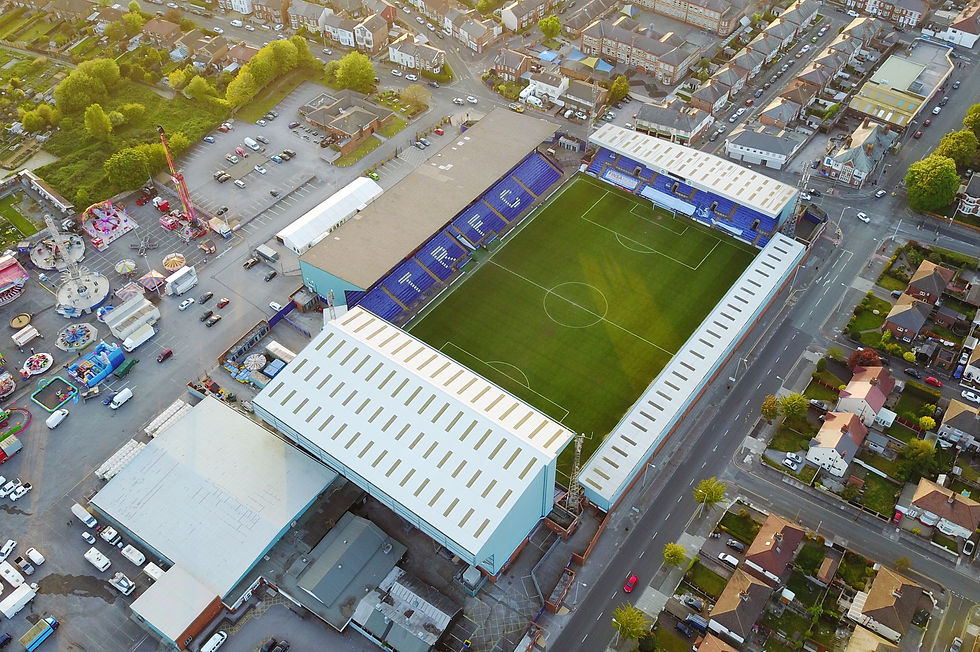
With the advent of the Taylor Report in the wake of the Hillsborough Disaster in 1989, all clubs in the top two tiers of English football were required to convert their grounds to all-seater stadiums. Tranmere Rovers, then playing in what would become the First Division, complied by redeveloping Prenton Park throughout the early 1990s. The ground was transformed into a modern, all-seater stadium with a capacity of around 16,500. Key features included the construction of the large, two-tiered Kop Stand behind one goal, providing a focal point for the most passionate supporters. The Main Stand was refurbished, the Johnny King Stand was constructed opposite it, and the Cowshed Stand completed the quartet of developments, bringing the stadium into the modern era.
Prenton Park has not only been the venue for Tranmere Rovers men’s matches but also for Tranmere Rovers Women and Liverpool Women, as well as hosting youth and reserve fixtures. It has played host to international football as well. In 1995, the ground was selected as one of the venues for the UEFA European Under-16 Championship held in England. Prenton Park hosted several matches during the tournament, bringing a touch of continental flair to the Wirral and providing local fans with a rare chance to see international football in a familiar setting. The event further cemented Prenton Park’s place on the footballing map.
Off the pitch, the club’s commitment to community work has been well recognised. Tranmere Rovers in the Community, the club’s charitable arm, has been active in using the stadium as a base for outreach programmes. From educational initiatives to health and wellbeing support, the stadium has acted as more than just a football ground—it has become a community hub.
In terms of silverware, Tranmere Rovers' most notable achievement came in 1990 when they lifted the Leyland DAF Trophy (now known as the EFL Trophy) at Wembley Stadium, beating Bristol Rovers 2-1 in front of a jubilant travelling support. They repeated this feat in 2021 when, after a dramatic and disrupted season due to the COVID-19 pandemic, they won the Papa John’s Trophy final against Oxford United. These triumphs were significant not just for the silverware but for the sense of pride and achievement they brought to the club and its loyal following.
The FA Cup has also delivered memorable moments. In 2000, Tranmere famously beat Premier League side Everton 3-0 at Goodison Park in the fourth round, an iconic result that echoed far beyond Merseyside. That same season, the team reached the quarter-finals of the FA Cup, only narrowly losing to Newcastle United. These giant-killing exploits captured the imagination of football fans nationwide and showcased the club’s ability to compete with much larger teams. Another highlight came in 2001, when Tranmere overturned a 3-0 deficit to beat Southampton 4-3 in one of the most remarkable FA Cup comebacks ever seen.
Prenton Park has continued to be at the heart of Tranmere’s identity through the ups and downs of the footballing pyramid. The club suffered relegation from the Football League in 2015 after a disastrous campaign, dropping into the National League for the first time in 94 years. However, under the guidance of Micky Mellon, the club mounted a strong recovery and earned promotion back to the Football League in 2018 via a dramatic play-off final win over Boreham Wood at Wembley. They followed this up with another promotion the following season, reaching League One before being relegated again during the COVID-curtailed 2019–20 season, which saw clubs' fates decided on a points-per-game basis.
In terms of the future, there have been discussions about further improving Prenton Park, although no large-scale relocation is currently being considered. Plans have included updating fan facilities, improving hospitality and media areas, and ensuring the ground remains compliant with modern accessibility standards. Sustainability has also become a focus in line with growing environmental awareness, with the club looking into ways to make the stadium more eco-friendly through energy-efficient lighting, waste reduction, and local engagement.
Tranmere Rovers’ long-standing association with Prenton Park has made the ground a central figure in the club’s narrative. Its traditional four-stand design, proximity to local communities, and storied history of drama and success give it a unique character. Unlike the sweeping modern arenas of the Premier League, Prenton Park has retained an old-fashioned charm, connecting generations of supporters to their club’s legacy. The stadium has seen legends such as John Aldridge, Pat Nevin, and Ian Muir don the Tranmere shirt, and it continues to welcome fans week in and week out, regardless of the division the club plays in.
With its century-long history and integral role in Merseyside football, Prenton Park is more than just a venue. It’s a landmark of resilience and aspiration. The club may not have enjoyed the wealth or profile of its cross-river neighbours, Liverpool and Everton, but Tranmere Rovers and their faithful home ground represent something equally valuable: tradition, community, and the enduring spirit of the English game. Whether it’s under the Friday night lights or on a rain-soaked Saturday afternoon, Prenton Park remains a beacon for those who love football in its most heartfelt form.


Comments