


Wembley Stadium
- Jimmy Muir

- Feb 16
- 7 min read
Wembley Stadium, often dubbed the "home of football," is more than just a sports arena—it is a cultural and historical icon woven into the fabric of British life. Located in the northwest of London, Wembley has played host to the nation's most memorable sporting and musical moments, from World Cup glory in 1966 to the anthems of global rock legends. This history explores both the original Empire Stadium (1923–2000) and the current Wembley Stadium (opened in 2007), providing a detailed look into their architecture, events, and lasting legacy.

Origins and the Empire Exhibition
The idea for a grand stadium in northwest London emerged in the early 1920s as part of preparations for the British Empire Exhibition, a showcase of industry and culture from across the British Empire scheduled for 1924–25. The selected site was in Wembley Park, a former pleasure ground served by the Metropolitan Railway. Architect Sir John William Simpson and engineer Maxwell Ayrton were commissioned to design the new stadium, with construction overseen by Sir Robert McAlpine.
Despite being built in just 300 days, the Empire Stadium was an architectural feat. It cost £750,000—an enormous sum at the time—and boasted a capacity of 125,000. Most iconic of all were its twin towers, which quickly became symbolic of British sporting excellence. Though constructed primarily for the Exhibition, the stadium was inaugurated early to host the 1923 FA Cup Final.
The "White Horse Final" and Early Years
The stadium’s debut on 28 April 1923, for the FA Cup Final between Bolton Wanderers and West Ham United, proved historic and chaotic. With an estimated 200,000 spectators turning up—many more than the official capacity—crowds spilled onto the pitch. Mounted police, including one officer on a white horse named Billy, cleared the field, enabling the match to go ahead. The event became known as the "White Horse Final" and firmly established Wembley’s place in football folklore.
Though intended to be dismantled after the exhibition, the success of the 1923 final and the stadium’s central location ensured its survival. In 1924, the Football Association acquired the lease, and Wembley began its journey as the national stadium of England.
Between the Wars: Growth of a National Symbol
In the years following its opening, Wembley Stadium became a central venue for football and other events. The annual FA Cup Final became a national tradition, and the stadium began hosting matches involving the England national team. It also welcomed Olympic events, speedway racing, rugby league Challenge Cup finals, and greyhound racing.
The stadium's early decades saw relatively few architectural changes. Its capacity was reduced slightly to increase safety and spectator comfort, but the twin towers and vast terraces remained defining features. During this time, Wembley became increasingly associated with national pride, sporting excellence, and mass gatherings.
Post-War Glory and 1966 World Cup
Following World War II, Wembley Stadium emerged as a key part of Britain’s recovery and cultural renaissance. The 1948 Summer Olympics, dubbed the "Austerity Games," were hosted at Wembley, and the stadium was the centrepiece of the event. Athletics, football, and ceremonies all took place within its walls.
Wembley’s most iconic moment came in 1966, when England hosted and won the FIFA World Cup. The final, played on 30 July, saw England defeat West Germany 4–2 after extra time, with Geoff Hurst famously scoring a hat-trick—still the only player to do so in a World Cup final. The immortal words of commentator Kenneth Wolstenholme—“They think it’s all over…it is now!”—etched Wembley into the global sporting imagination.
Beyond Football: Music and Cultural Events
While football remained Wembley’s primary focus, the stadium increasingly hosted major music concerts and cultural gatherings. The most notable was Live Aid on 13 July 1985, a dual-venue charity concert held in London and Philadelphia to raise money for famine relief in Ethiopia. Wembley’s portion, attended by 72,000 people and watched by millions worldwide, featured Queen, U2, David Bowie, and The Who, among others. Freddie Mercury’s performance with Queen is often cited as one of the greatest live shows in music history.
The venue also welcomed the likes of Michael Jackson, Madonna, The Rolling Stones, and Tina Turner, as it evolved into one of the world’s premier live performance arenas.
Decline and Call for Redevelopment
By the 1990s, the Empire Stadium was showing its age. Though still iconic, its facilities were outdated, its sightlines compromised by the running track, and its infrastructure no longer met modern safety standards. Calls for a new national stadium grew louder.
In 1996, England hosted the UEFA European Championship (Euro ’96), and while Wembley was the setting for the final, its shortcomings were evident. The stadium lacked the corporate amenities and modern comforts that newer arenas offered.
In 1998, the government and the Football Association agreed that Wembley would be demolished and replaced by a state-of-the-art venue that could once again symbolize British sporting ambition. Demolition began in 2002.
The New Wembley: Design and Construction
The new Wembley Stadium was designed by Foster + Partners and HOK Sport (now Populous), with engineering by Mott MacDonald. The centrepiece of the new design was the Wembley Arch—a 133-metre-tall, 315-metre-long steel structure that soars above the stadium. Visible across London, the arch replaced the twin towers as the stadium's defining architectural symbol.

Construction was plagued by delays and budget overruns. Originally set to open in 2003, the project was completed four years behind schedule at a final cost of around £798 million. Nevertheless, when the new Wembley opened in 2007, it was one of the largest and most technologically advanced stadiums in the world.
With a seating capacity of 90,000, Wembley became the second-largest stadium in Europe, after the Camp Nou in Barcelona. The bowl-shaped design ensured excellent views from every seat, while hospitality suites, retractable roofs, and media facilities brought it in line with global standards.
A New Era of Football and Events
The new Wembley hosted its first competitive match on 19 May 2007—the FA Cup Final between Chelsea and Manchester United. The match marked the beginning of a new era, with the stadium reclaiming its place as the spiritual home of English football.
Since then, Wembley has hosted annual domestic cup finals (FA Cup, League Cup), the FA Community Shield, England home matches, and the promotion-deciding EFL Championship play-off final. The stadium was also a key venue for the 2012 London Olympics and hosted multiple matches during the UEFA Euro 2020 tournament, including the final between England and Italy.
International Football and the NFL
Beyond English domestic football, Wembley has played a growing role in the international sporting calendar. In addition to World Cup and European Championship qualifiers, the stadium has welcomed prestigious friendlies and club competitions.
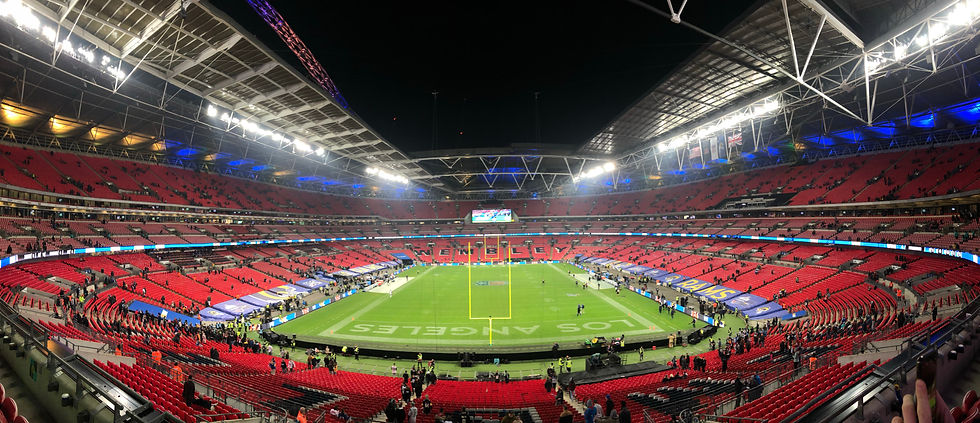
Since 2007, Wembley has hosted regular-season National Football League (NFL) games as part of the NFL International Series. American football has proved popular in the UK, with sell-out crowds attending games featuring teams like the New England Patriots, Dallas Cowboys, and Jacksonville Jaguars. The NFL’s long-term partnership with Wembley highlights the stadium’s global reach.
Other Sports and Major Events
Wembley has proven itself as a truly multipurpose venue. It has hosted boxing world title fights, including Anthony Joshua’s heavyweight battles, and rugby league’s Challenge Cup Final returned to the stadium in 2007 after a hiatus during construction.
In 2011 and 2013, Wembley hosted the UEFA Champions League Final—first between Barcelona and Manchester United, and then between Bayern Munich and Borussia Dortmund. Both events showcased the stadium’s excellence as a venue for elite-level European competition.
In 2024, Wembley was chosen once again to host the UEFA Champions League Final, a testament to its enduring status in global sport.
Musical Legacy Continued
The musical tradition established by the old Wembley lives on in the new. Artists like Adele, Beyoncé, Ed Sheeran, and Coldplay have all performed multiple nights to sold-out crowds. In 2023, Taylor Swift announced six dates at Wembley as part of her record-breaking "Eras Tour."
Whether it’s pop, rock, or hip hop, the stadium is seen as a benchmark for musical success—an artist’s arrival on the global stage.
Cultural Symbolism and National Identity
Wembley has long transcended its physical role as a stadium. It is a place of national pilgrimage, emotion, and shared memory. From the national anthem ringing out before England internationals to the floodlit arch glowing over northwest London, Wembley evokes passion, unity, and history.
It is also a reflection of the UK’s broader journey—from imperial ambition to post-war rebuilding, and into the era of global sports and entertainment.
Criticism and Challenges
Despite its status, Wembley has not been free from controversy. The spiralling costs of the new stadium led to political and media scrutiny. Criticism has also focused on ticket prices, transport issues, and the decision to host non-football events such as boxing or concerts on the sacred pitch.
In 2018, there were discussions about selling the stadium to American businessman Shahid Khan, owner of Fulham FC and the Jacksonville Jaguars. The proposal, which would have seen Wembley owned privately for the first time in its modern history, sparked widespread public and media backlash and was ultimately withdrawn.
Looking Ahead: The Future of Wembley
As of the mid-2020s, Wembley remains central to English football and cultural life. Future plans include expanding its accessibility and improving transport links, especially as urban development around Wembley Park accelerates.
Sustainability is also a growing focus. New initiatives aim to reduce the stadium’s carbon footprint and enhance its role as a green, efficient venue in line with 21st-century expectations.
Conclusion
From the Empire Stadium of 1923 to the state-of-the-art arena of today, Wembley has evolved alongside the nation it represents. It has borne witness to triumph and tragedy, from World Cup glory to heartbreaking near-misses. Yet through it all, Wembley has remained a symbol of aspiration, identity, and unity.
Whether bathed in sunlight for an FA Cup Final, glowing under floodlights for a Champions League showdown, or echoing with the voices of 90,000 concertgoers, Wembley is not just a stadium—it is a national institution. Its story, nearly a century in the making, continues to unfold with every roar, every goal, every chorus. Wembley is, and always will be, the heart of English sport and culture.


Comments